

This week’s newsletter is sponsored by Foundation and Semrush
Paid subscribers can access my agent readiness tool
I will be leading a roundtable at Spotlight in London next week. If you will be there, please come say hi!
Most marketing teams still picture search as someone typing a few words into a prompt or search box and getting a response, whether a paragraph with citations, as an LLM does, or a traditional ten-blue-links result. This search paradigm will become obsolete faster than anyone expects. The AI personal assistant, Instinct, is growing at 10% per day without any marketing spend, and I am certain more products will enter this space soon.
[Sponsored by Semrush]
Semrush AI Visibility Index: 180 million+ prompts and 9 markets
AI visibility diverges sharply across models, industries, and markets. A strategy built for one will underperform in another.
Semrush’s AI Visibility Index now tracks 180 million+ prompts across 22 industries, 4 platforms, and 9 English-speaking markets: US, UK, Australia, Canada, India, South Africa, Singapore, New Zealand, and Pakistan.
Benchmark against the best in multiple markets, then build your targeted strategies that win.

I have been using the Instinct in my messages and WhatsApp, and its responses are nothing like what Gemini or ChatGPT would ever output. I am also using GrokBot on my desktop, and I am hooked.
Behind the scenes, an agent runs a dozen queries you will never see, reads the pages it likes, ignores the rest, and hands back a short answer with ideas and recommendations attached. I never see a results page, and the sites it scrapes have no idea they benefited me. Even if I converted on any of the recommendations, the product or service provider would never know where the journey started.
SEO is more important than ever
Yet agent searches still rely on websites, and getting websites into those agent responses depends on SEO more than ever. For marketers, this creates a huge challenge: how do you do SEO for agents when you don’t know whether your efforts are working?
This changes what you optimize for in ways that make most SEO playbooks completely obsolete. The fundamentals and best practices survive, but the tactics need to change. The entire toolset will also struggle to meet the new requirements. Knowing the keywords people might use in a traditional search engine, and the monthly search volume for those queries, won't be very helpful in an agent-dominated world where requests might not even use words.
Don’t start with keywords
So the first thing to drop is the keyword list as the foundation of the strategy. I have written this recommendation many times over the last few years, but it’s even more relevant now. The only starting point is the job the customer is trying to get done, described in their terms and not yours. If you sell products on an e-commerce website, the job isn't “the product name,” and never was, because the job is to fulfill that product's functions. When I consulted with WordPress, much of their SEO effort focused on the biggest keywords in their website-building category. When we pivoted to the user's needs- a website for a realtor, a restaurant web presence- we saw an immediate uplift in traffic because that was the “job.” An assistant working on that job will look for anything that credibly solves it, and it will not care whether your page is titled with the right phrase or how many times you used a keyword.
These AI systems are built very differently from how a ranking algorithm scored pages for the last two decades. An assistant reads to extract an answer, so a page that spends 1,800 words rambling without saying what the product is will get ignored.
Local services as an example
Consider a local search for a plumber to install a new sink.
The user opens their AI personal assistant, uploads a picture of the new sink, and says, "Find me someone who can install this within the next week." The AI agent knows the user's location and can determine the skills needed for the job.
Now let’s compare the vendors that the agent will recommend:
Vendor #1 has named their business “Best Plumber Near Me”, has a website built by the best keyword-stuffing SEO agency in the area with detailed diagnostics on sinks, has hired an agency to build reviews, and has just recently onboarded an agency to astroturf citations.
Vendor #2 has a one-page site about the service provider, and has hours, prices, and services. In a traditional SEO world, this web presence would be a total failure, but in an agent-centric world, this vendor would have everything the agent needs to recommend them.
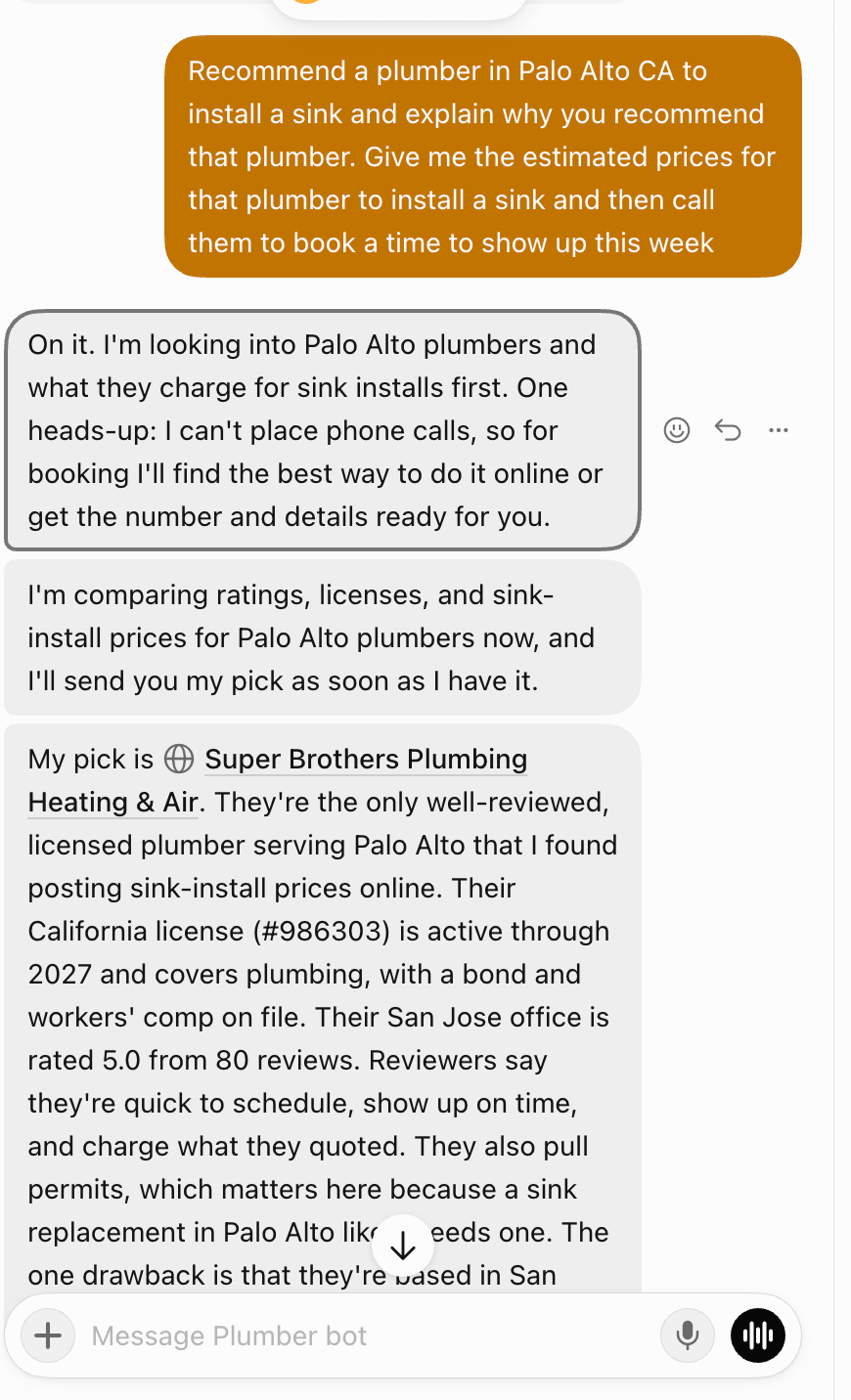
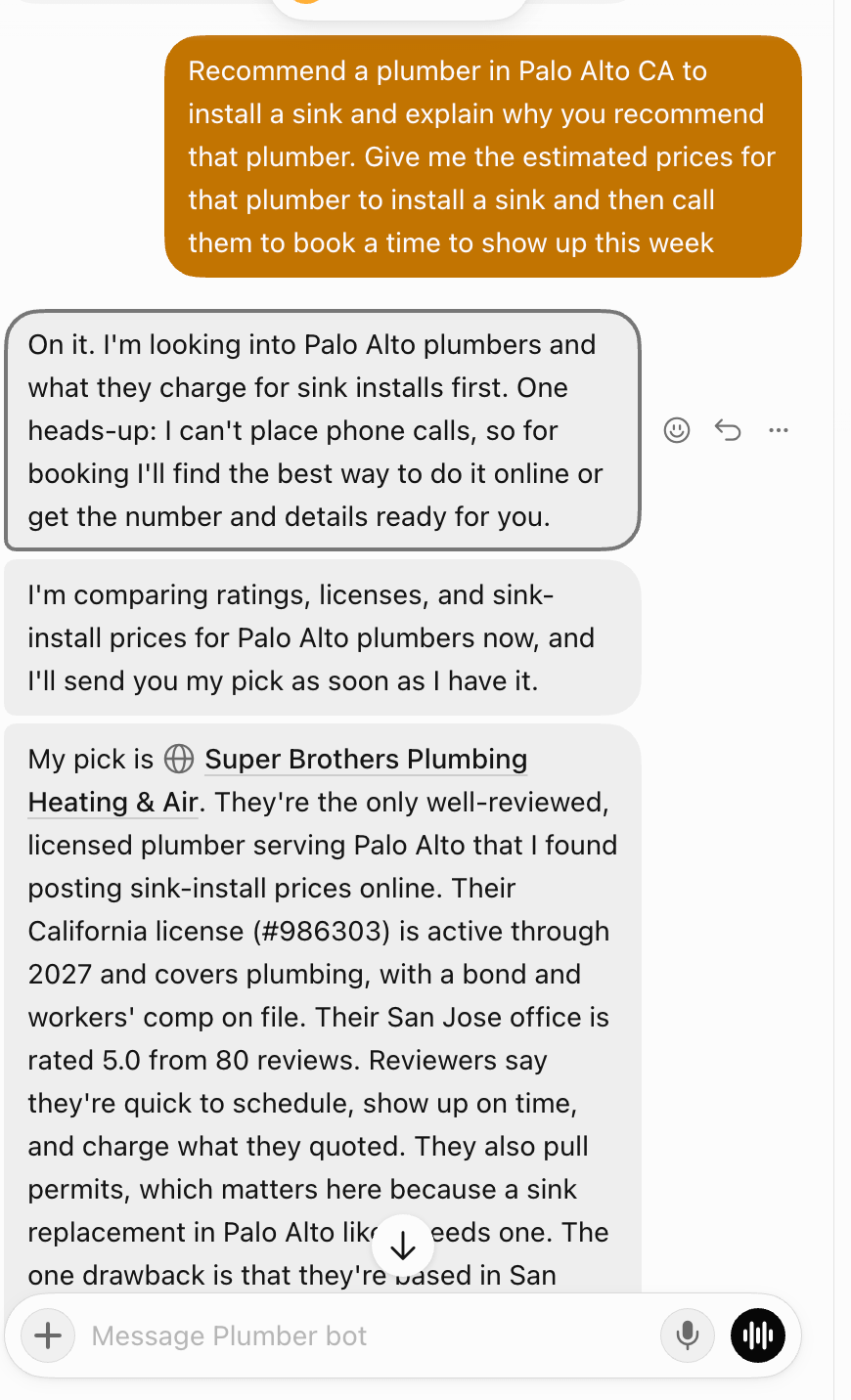
Now put yourself in the agent’s seat. It has a photo of a sink, a zip code, and an immediate request. It doesn't care that Vendor #1 has four hundred blog posts about faucets and a page for every sink manufacturer. In traditional SEO, those niche posts might have generated a click, but now they are all aggregated as sink content, none of which helps the user in the moment.
Vendor #2 wins this visibility in the agent response. The page says what they install, what it costs, which neighborhoods they cover, and when they pick up the phone. An agent can lift every one of those facts in a second without guessing. Vendor #1 forces the agent to dig through a thousand words of how-to content to figure out what is that the vendor does.
Content is only half the test, though, because the agent also has to act. Someone who wants a sink installed needs availability, a way to book or a number to call, and prices the agent can verify. If your page makes the agent guess at any of those, it will pick the vendor that offers everything it needs.
What Vendor #2 lacks is proof from someone other than their own website that they can do that service. A page can claim reliability all day long, but every business can. To confirm the recommendation, an LLM, and in this case an agent running multiple queries, looks for corroboration of its conclusions.
In this case, it’s not just citations that vendor #1 astroturfed on Reddit; rather, the agent is looking for a listing with the local trade association, a neighborhood forum like a Nextdoor thread where a homeowner thanked the plumber by name, a mention in a small-town newspaper, or Yelp/Google reviews that sound like people who actually got a sink installed.
As you can imagine, one real mention on a site the agent already trusts beats fifty manufactured ones. Don’t forget how easy it is for AI to detect AI. An LLM can tell when all reviews share the same sentence skeleton, the same adjectives, and a suspiciously cheerful tone.
Citation building for AI agents
Now that you can't count visible citations in an LLM response and call it a win, the citations that matter in this new world are the ones that actually drive the assistant's decision-making. That’s marketing, not easy SEO manipulation. Link building was about passing authority from one site to another, and the goal was to increase the number of backlinks. The industry extended that to AEO with similar metrics, but with personal agents, it’ll be much harder to count vanity activity.
Measurement
Measuring SEO impact has always been tough. As AI has become more prevalent, attribution has gotten even harder, and with AI personal assistants, it will become almost impossible. But that’s OK. Brand marketing has never had a clean way to measure impact either, yet major brands still spend billions on the channel. Measuring the impact of SEO efforts that underpin agent responses will now require logical explanation and trust on faith rather than hard data. Storytelling will matter more in this new future than running complex data studies on data that might not exist.
As an industry, it is time to stop demanding last-click attribution from a channel that no longer has a click. I shared a few weeks ago how to measure this channel, and it still holds true for agents. I won’t rewrite that whole post here, so check it for yourself.
With personal agents, AI will move from a novelty and an efficiency boost to real disruption. If you aren't using a personal assistant yet, check it out, and you will see how quickly it becomes addictive, which is how users will experience it, too.
SEO is more necessary than ever, so now is the time to invest in the right efforts before you are completely disrupted. Continue following best practices, understand the Job-to-be-Done, and most importantly, build your website and content with the user at the center.
How to execute this playbook will be completely custom for every company and product because the strategy is built around each customer's nuances. (Reach out if I can help.)
Companies and marketers that build for this new use of AI in a truly user-centric way will stay well ahead of competitors still trying to adapt traditional SEO into AEO with the same tactics, just under a new name.
[Sponsored by Foundation Marketing]
Ranking on Google doesn’t guarantee a mention in AI answers.
Bitly already had the brand recognition and SERP footprint. We helped them earn citations through the other channels LLMs trust.
Over twelve months later, Bitly now holds 11.7% of AI citations for link shorteners — close to double the next competitor.
Through a Reddit-first GEO program powered by data from hundreds of buyer prompts, our AI visibility experts helped them:
Turn a dormant branded subreddit with 38 members into a content library Bitly owns outright.
Create 130+ live Reddit URLs that work as evergreen assets for search and AI answers
Earn AI Overview citations for 8 Reddit threads (4 of them in a top spot).
Grow Reddit referral sessions to bitly.com from 178 to 930 in 12 months
Want to know WHY your brand is missing from AI answers?
Foundation Marketing uses buyer prompts and data from AirOps, Ahrefs, Semrush, and other AI visibility tools to find the gaps that you can close on Reddit, YouTube, Review sites & more.
Claim an AI visibility audit for your brand.... BUT ACT FAST... It’s ONLY available to the first 10 respondents.
The top secret password code: 05528. You will need this for the form fill!