

This week’s newsletter is sponsored by Foundation and Semrush
Paid subscribers can download this audit template for Jobs to Be Done to ensure that their AEO efforts are aligned with users, not algorithms
I will be discounting my Intro calls next for one day only; message me if you want to be notified when that happens
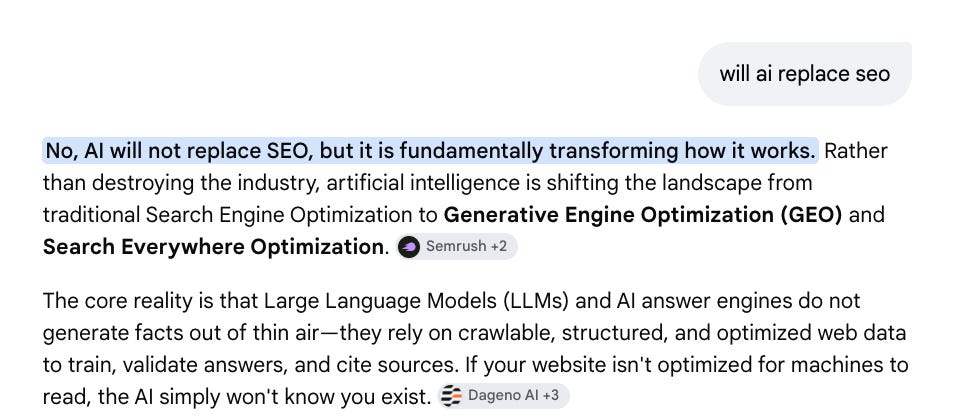
Fear is a common concern in marketing, and I hear it from just about everyone I meet. Fear that AI will replace our jobs. Fear that our employers and clients won’t need us anymore. Fear that everything we know is now obsolete. But the fear is misplaced; instead of playing defense, we need to pivot to offense.
The entire conversation about answer engines destroying organic traffic misses the point: users aren’t suddenly demanding more goods and services; the journey has changed. I want to introduce you to a playbook that turns this fear into an operating playbook, with the acronym F.E.A.R.
[Sponsored by Semrush]
When the stakes are high, AI citation patterns change
In everyday or commercial queries, brand-owned content earns citations. But when users ask AI about their health or finances, the rules change. Government and official sources dominate, Citation Cores shrink, and brand content struggles to cut through.
Semrush’s latest YMYL Mini Study maps the trends in AI sources when the stakes are highest, across 22 topics, four platforms, and millions of prompts.
If your brand operates in finance, health, or any high-trust category, this changes how you need to approach your AI visibility.

Be your customer - Empathy
User centricity is a popular marketing buzzword, but for most people, it's just a term. When I talk about empathy in marketing, I mean you need to sit through customer conversations and listen for the problem that made someone search in the first place. Not why they search for your product. Why they search for anything related to their problem. This isn’t market research; it’s human understanding.
When I was at SurveyMonkey, I was an avid user of the product, and I knew the search process and onboarding flow because I was a customer. When I consulted for Gusto, I started using the product, so I understand not just the search terms, but why I used those queries. When I consulted for Coinbase, I proactively learned everything I could about crypto, so I could think like a user. Empathy is not just trying to think like a customer; it is actually being that customer.
This is where most teams fail when they build an SEO plan, and now an AEO strategy. They sit in a room and guess at what customers want based on what the product team built. I’ve sat through enough of those potential client meetings to know that what these teams come up with is almost always wrong. (My favorite ‘misses’ are the ones I hear from companies targeting children as a user group without ever talking to people who deeply understand children's needs. Their user centricity is just an adult’s version of what they think children want.") Real empathy means extracting actual friction from real conversations, not inventing it.
Build something that can’t be summarized into an overview - Assets
Once you know what the customer is actually seeking when they do a search, you build an asset around that specific worry. This is product-led SEO, but in a more advanced form because it’s not just SEO; it’s product and marketing wrapped into one.
When you do this process, you discover that users aren't looking for a blog post comparing you to competitors that matches some keywords. This is what people at the bottom of the funnel search for, not the mid-funnel that makes the most sense for AEO, or the top of the funnel that is SEO. Generic, non-proprietary content gets absorbed into an LLM overview in seconds, and your brand gets mentioned once. In this part of the process, you build something that solves the specific problem at the current stage in the user journey.
For ecommerce, this is simple: it’s the product or category landing page, but for SaaS it requires much more thought. A product for the user is not just content; it is whatever the user needs. The harder this is to come up with and build, the stronger your moat will be.
Build citations - Reputation
When search engines and language models evaluate what a brand stands for, they’re looking for signals that multiple independent sources agree on something. The brands that get cited consistently aren’t the ones with the best backlinks; they're the companies that have done the most effective brand work to deserve an LLM recommendation - essentially what brand marketing does.
In an AEO world, authority isn’t earned by having perfect SEO scores. Authority comes from multiple credible sources independently saying the same thing about what you do, and that consensus has to be genuine because models think and can tell when you’re faking it.
The reputation part of AEO is more than just accruing citations; it’s proactively building and reflecting the reputation that you deserve.
Iterate and improve - Feedback
There is no set-it-and-forget-it in organic digital marketing. Brands that maintain visibility through every model update look at what’s happening every week and adjust immediately when something shifts.
A consumer platform I worked with got LLM citations for a specific use case. Conversations with sales and support showed a different need was surfacing in AI responses. Their consistent feedback cycle caught it fast. The assets they created and citations they built for this new use case generated even more visibility.
Your feedback cycle needs a regular cadence because conditions change constantly. What your sales team is hearing this month might be completely different from what they heard last month. Marketers who succeed in this new environment will keep learning and improving based on what they learn from testing. Flexibility and internal diplomacy are better skills to hire for and optimize than ever.
Feedback, Empathy, Asset, Reputation - F.E.A.R in action
Current fear around AI is backward. You think AI is coming for your job. Actually, AI just made it obvious which marketers were always phoning it in, guessing what customers want, and running SEO playbooks that were already obsolete. These are the same people who adapted to AI by building content that could be summarized into nothing in seconds, or by updating recommendations to include an LLMs.txt.
Using this playbook will separate marketers who own their category from marketers who chase every algorithm rumor. Guessing is what happens when your content strategy comes from “we think people want to know about our features.”
In the next few years, the marketers and brands that own their category will be so aligned with what their customers actually need that the algorithm and models will have no choice but to surface them. When you understand your customer’s needs, build something that solves them, earn reputation by doing work that matters, and iterate faster than the market moves, you’re aligned with your customers, which is exactly what SEO and AEO should have always been.
Instead of fearing the future, reclaim it by proactively building for today’s AI-enhanced buyer journey with F.(eedback), E.(mpathy), A.(ssets), and R.(eputation).
F.E.A.R. is a permanent rhythm, not a sprint, and it will hold through every algorithm and model update because it’s centered on the user, not the medium or the search engine. AI models and search algorithms will update, but user needs are a lot more static. Buyers will always need the products you are selling; only the journey to purchase them will change.
Build for humans, not for machines.
[Sponsored by Foundation Marketing]
Ranking on Google doesn’t guarantee a mention in AI answers.
Bitly already had the brand recognition and SERP footprint. We helped them earn citations through the other channels LLMs trust.
Over twelve months later, Bitly now holds 11.7% of AI citations for link shorteners — close to double the next competitor.
Through a Reddit-first GEO program powered by data from hundreds of buyer prompts, our AI visibility experts helped them:
Turn a dormant branded subreddit with 38 members into a content library Bitly owns outright.
Create 130+ live Reddit URLs that work as evergreen assets for search and AI answers
Earn AI Overview citations for 8 Reddit threads (4 of them in a top spot).
Grow Reddit referral sessions to bitly.com from 178 to 930 in 12 months
Want to know WHY your brand is missing from AI answers?
Foundation Marketing uses buyer prompts and data from AirOps, Ahrefs, Semrush, and other AI visibility tools to find the gaps that you can close on Reddit, YouTube, Review sites & more.
Claim an AI visibility audit for your brand.... BUT ACT FAST... It’s ONLY available to the first 10 respondents.
The top secret password code: 05528. You will need this for the form fill!