This week’s newsletter is sponsored by Airops
[sponsored]Your competitors are beating you at citations in AI. Visibility+ from dofollow.com helps brands improve visibility across AI answers AND traditional search. See where competitors are ahead
Paid subscribers can download this tool to build an HTML sitemap
Refer friends as subscribers and earn rewards
A few weeks ago, I wrote that internal links are one of the most powerful levers anyone can use on their site to improve technical SEO, and they cost almost nothing. I received feedback that it’s not really free because many SEO teams don’t have enough ownership to build an internal linking process, and the best they can do is manually insert links into blog posts. That manual work, of course, isn’t free.
I gave the people who reached out a one-off suggestion to further improve their internal linking, and this tip should be accessible to almost everyone. I've used it in multiple instances when I couldn't insert internal links across a site, and it worked like magic.
[Sponsored by Airops]
Targets went up this year. Budgets mostly didn’t.
AirOps surveyed 300+ CMOs and VPs of Marketing to find out how leaders are actually closing that gap, and the numbers are sharper than I expected. 75.4% got hit with higher targets this year. Only 43.0% got more budget to match. Everyone else is finding the difference somewhere else, in headcount, in tooling, in what they choose to stop doing.
The part that stood out to me: 86.6% of leaders are now betting on AI search as a growth channel, but only 23% trust their own measurement of it. That’s either the biggest opportunity on the table right now or the biggest blind spot, depending on which side of that gap you’re on.
The report breaks down whether a team’s performance gap is an execution problem or a resourcing problem, which is a distinction most leaders never get data on. Over 620 marketing executives have already pulled a copy.

Build an HTML sitemap on a plain HTML page
This is not an XML sitemap, which is technically complex to build and has negligible value for search visibility. An HTML sitemap isn't about ranking signals or best practices; it's a hack to get internal links and improve discovery.
Here’s the difference between an HTML sitemap and an XML sitemap as I explain it to clients to encourage them to build one.
An XML sitemap is a manifest. It’s a file that tells a crawler what exists, so the crawler isn’t forced to stumble upon it by accident. This file is useful to crawlers but is mechanical and invisible to users. An HTML sitemap is a page, and it can be very helpful for discovery, even for humans. A person can land on it, click around, and actually use it to find something.
Let’s explain with an example.
When you are in an airport looking for a lounge and your gate, you don’t wander the terminal hoping you bump into either; you go find a structured map. That’s an HTML sitemap. It’s what you turn to when you don’t have time to check out every storefront. An HTML sitemap is a well-structured directory that shows what is nested under what. Sitewide navigation cannot accommodate all this nesting, especially on a large site with more than 1,000 pages.
An XML sitemap is an informational file of everything that exists. If you are building a tool to discover and rank an airport terminal, your tool might access an XML directory, but in the heat of the moment, that file is useless. In that respect, large sites can benefit from having an XML sitemap if a search engine or LLM wants to know everything on a website, but it doesn’t necessarily help a site rank internally in a way that benefits discovery. It creates a data feed that crawlers will use to build a crawl plan.
In its most basic form, an HTML sitemap is just a list of links. When you link that HTML sitemap from a homepage, it can help ensure every page is within 3 clicks of the root, as we discussed in that internal linking post. A sitemap that lists every page eliminates orphan pages that might not have any internal links, because if every page is on the sitemap, every page has at least one link.
Value of sitemaps
For a site of only a few dozen pages, an HTML sitemap might have only negligible value in improving discovery, but for a site with tens of thousands or millions of pages, the ROI of this one page is immense.
In many of my projects involving large sites, the HTML sitemap has had an immense impact. SurveyMonkey was the first place I tested this, and I built that HTML sitemap (Note: I built this in 2016; it probably could use an update) by exporting Screaming Frog output to CSV and then uploading it as HTML. Within days of launching the sitemap, some of our deepest templates suddenly started seeing crawler hits in the logs, followed soon after by search impressions and then clicks.
At Scribd, which had over a billion pages when I consulted for them, they saw a similar impact. Many large sites like Tripadvisor, Amazon, and LinkedIn use HTML sitemaps to list every page on their sites, thereby ensuring that, even with nested navigation, an XML sitemap still provides a page to facilitate a natural crawl.
LinkedIn has one of the most impressive HTML sitemaps I have ever seen. The sitemap is placed in the footer, but it’s only visible to logged-out users, which is exactly what search crawlers are. The people sitemap lists the top people at the top of the page, then paginates through every member in alphabetical order. They have a similar one for companies, products, jobs, and learning.
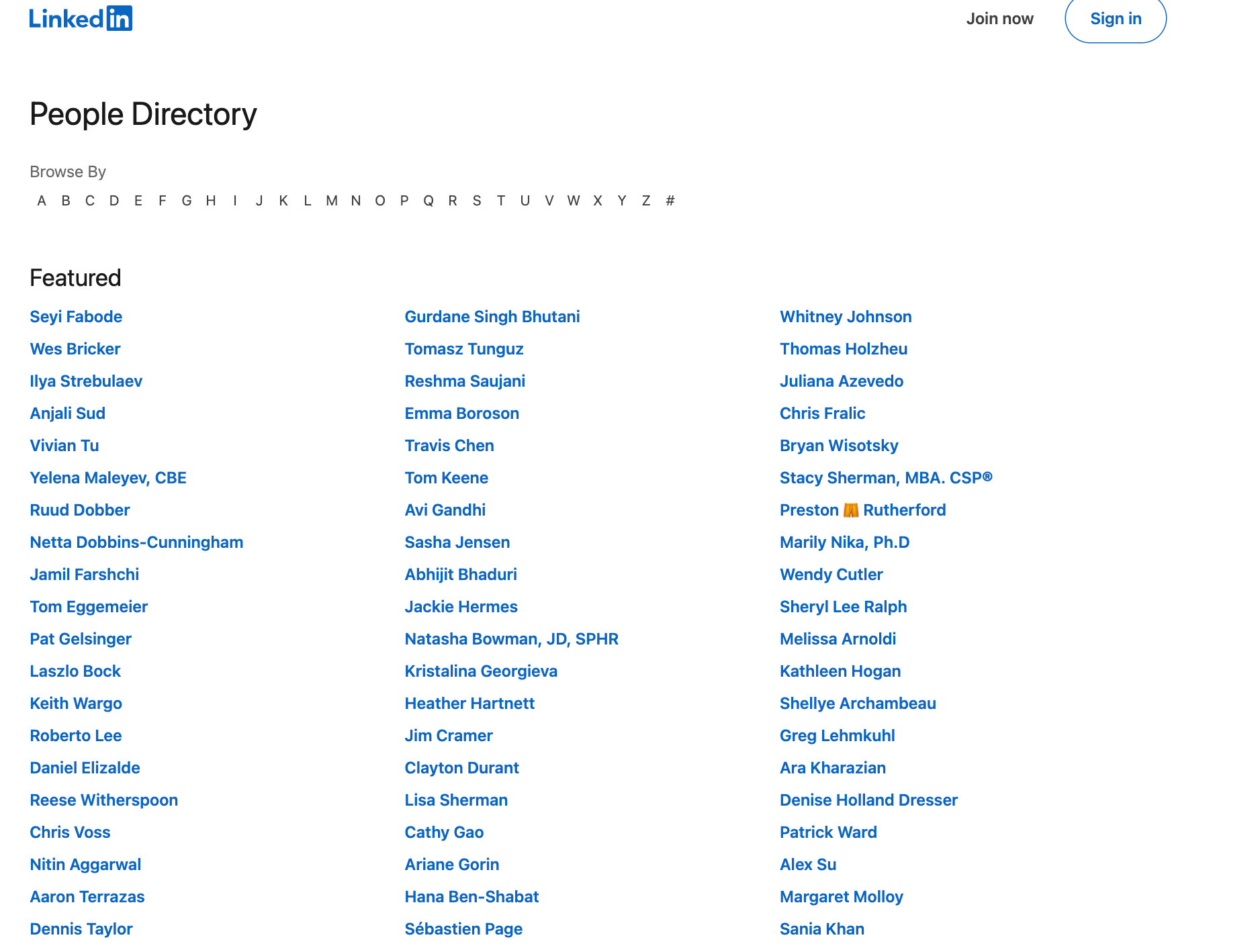
While I was fortunate to consult on LinkedIn’s SEO strategy and had access to their crawl and search data, I can’t conclusively say what this did for their crawl and visibility because I did not have a before picture of their visibility before they created the sitemap; however, based on my past experiences with sitemaps, I am certain that these HTML sitemaps are more effective for their crawl visibility than the XML sitemap.
Sitemaps for LLMs
We’re no longer just building pages for search crawlers and human visitors. A third audience now behaves differently from both. AI crawlers and the retrieval systems behind LLMs don’t browse like a human, clicking through a mega-menu and hovering over categories. They also don’t crawl with the patience of a traditional search bot willing to grind through a site depth-first over weeks. They tend to fetch, extract, and move on, often working from a narrower slice of a site than Googlebot ever bothered with.
An HTML sitemap gives that third audience the same gift it gives everyone else: a flat, legible map of what your site actually contains, described in your own words rather than inferred from a navigation tree. When your product pages, blog posts, documentation, and use case pages all sit in one linked structure with anchor text describing each one, you’ve made it dramatically easier for a retrieval system to find and understand every page.
These discovery crawlers or bots can’t parse every internal link, so an HTML sitemap is even more useful.
Building an HTML sitemap
Unlike an XML sitemap, which requires some technical work, this doesn't require a redesign or a long engineering sprint. Many CMS platforms have plugins that automatically generate the basics. For anything larger or messier, you run a crawl with Semrush, Ahrefs, Screaming Frog, or whatever tool, pull the full URL list, and organize it by theme instead of dumping it out as one undifferentiated wall of links, which is helpful for users, but potentially unnecessary for the crawlers. Any LLM can help you organize it, so this shouldn’t be much work.
Once you have that page, link to it somewhere a visitor will actually find it; the footer is fine, just make sure it survives the next site redesign because lists of URLs are the kinds of pages designers love to kill.
Once it’s live, you can check Google Search Console pretty quickly (depending on the brand and authority of a site) to see whether pages that have hardly been indexed are now getting traffic.
Let me know if you try this and how it works for you.
Refer friends and colleagues to this newsletter, and you can earn rewards.