

Paid subscribers can download my ideal SEO job description
Over the course of my career, both in-house and as a consultant, I have worked with some genuinely exceptional SEO managers and in-house teams, people who understood the craft deeply, who built programs that compounded over the years with tangible business outcomes. All of those people share something that does not show up in most job descriptions, and the gap between what they do and what most companies hire for has only widened as the job has become more complex.
[Sponsored by Semrush]
Discover how people are really searching, discovering, and engaging online
AI continues to reshape how users discover, engage, and click across search environments. But most teams are still making decisions without a clear picture of what’s actually shifting.
The Datos State of Search Q1 2026 report, created in collaboration with Rand Fishkin, maps real search behavior across millions of users in the US, EU, and UK. AI adoption, regional contrasts, e-commerce discovery, and intent signals are all explored in detail using real clickstream data.
SEO is not a checkbox
The version of the role that most organizations seek and what many of their SEO employees fill is a ticket-creating function. This SEO manager sits between the many different teams and functions as an SEO toll booth, blocking other teams' progress to lift product launches into Google’s stated best practices.
If a feature request horrifyingly violates one of these guidelines, the SEO team will prevent a launch for the sake of SEO hygiene. One of my favorite types of calls I do on Intro is when I get to be the one to give the green light to “just do it,” because every SEO “expert” a company has hired has blocked true business progress. The toll booth does not build anything.
The SEO toll booth has the glorious job of translating requests into Jira issues and then waiting to see what ships. They don’t initiate strategy beyond checking SEO boxes, and their reporting consists of sharing rankings and now prompting visibility as though summarizing data were the same as driving results. When asked to tie those dashboards back to business metrics, they just can’t. The job has drifted so far from what actually drives business performance; it’s no surprise to me that companies are shedding SEO teams as they shift to AI-first thinking.
The org holds it back
This is not a personal failing of the people in those roles, and I have met many who would like to shift their responsibilities, but they can’t. The structure itself is broken. SEO got attached to marketing org charts as a channel rather than a capability, so the best they could do in this role is “conduct” the work of other teams. Engineering owns the infrastructure, while product builds the roadmap. SEO is left with just telling those other teams what to do. This is just an SEO suggestion box with a title.
Some in the marketing world are trying to address this problem by applying different titles to the same role. Calling an SEO manager an engineer without changing any expectations or reporting infrastructure doesn’t change the outcomes. Likewise, giving SEO teams new external tools doesn’t change much if they still lack control over the internal levers that drive progress. A new title attached to the same broken structure produces the same broken results.
This model was already showing cracks before AI started reshaping how answers get surfaced online, which is why my approach has been to put SEO into the product so the SEO team has access to internal levers.
User empathy is required
The next era of search will not reward people who are solely focused on managing workflows or keeping stakeholders informed about prompt visibility. Growth will come, as it always should, from people who understand what search users are actually trying to accomplish when they type a query or ask an AI assistant a question, and how a product's architecture can either support or destroy that intent at scale.
That is not a traditional marketing skill, nor is it purely a technical skill in the way most SEO practitioners use that word. As before, this is a product skill, specifically the kind of deep, user-obsessed, systems-aware product thinking that gets applied to the question of how search engines and AI models decide which answers deserve to be seen.
This person looks more like a product manager than anything else, and not a marketing engineer or a content strategist who has picked up a few technical certifications along the way. What I would actually look for in that person is a specific combination of capabilities that I have rarely seen packaged together in a single job description, but that I have consistently seen in the SEO managers who produced outsized results.
SEO managers are product managers
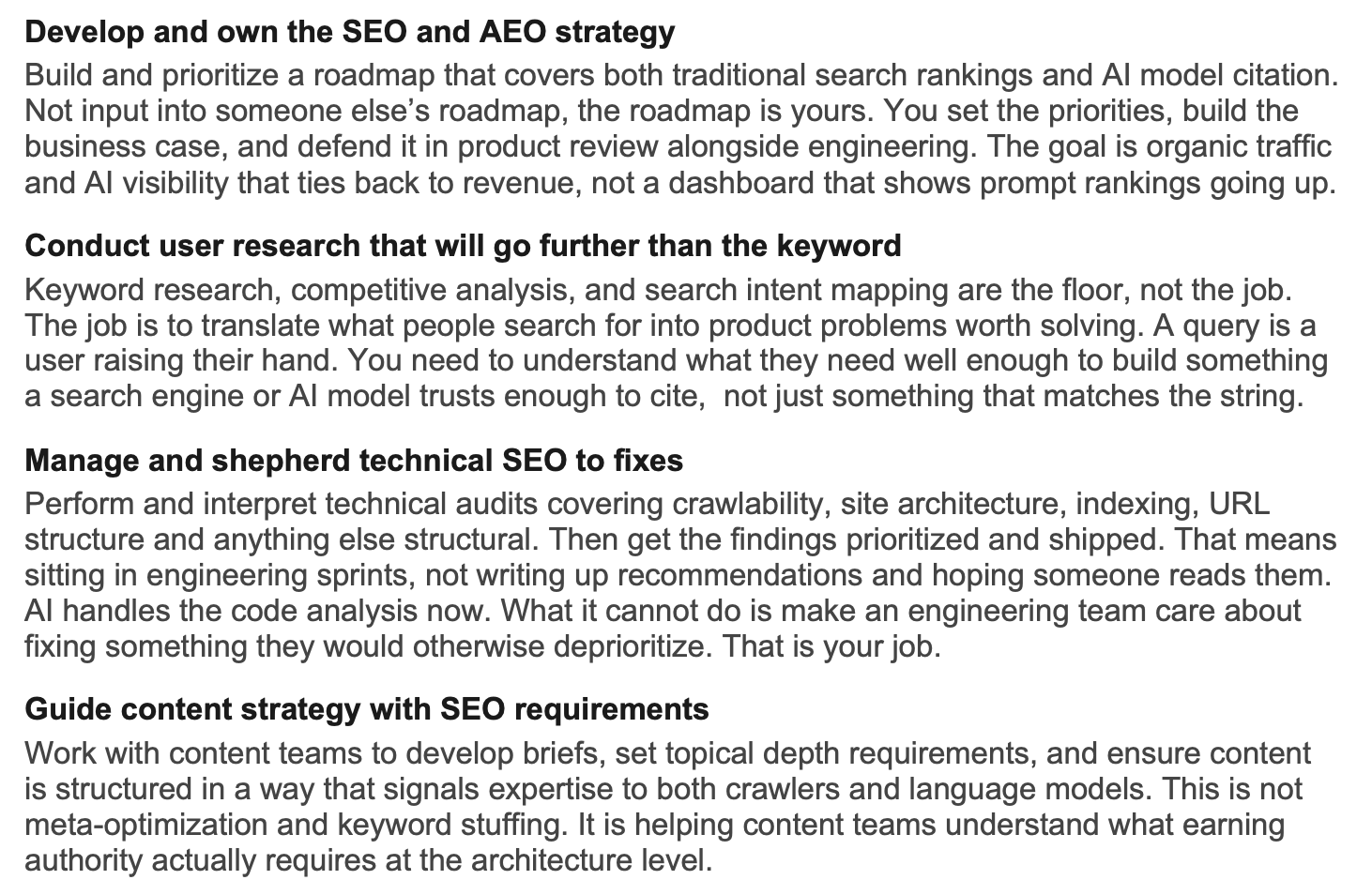
Let’s call this an SEO product manager, as I have argued many times in this weekly newsletter. This PM has to understand what a user means when they search, not just the words they type, and that requires genuine curiosity about people and problems rather than proficiency in a research methodology. The query is the user raising their hand to ask for something they need solved, and the job is to understand the problem well enough to build something that a search engine or AI model trusts enough to cite. The managers I have worked with who had this quality never needed to be told to think about the user first.
Naturally, we can’t just have a PM building something without also understanding SEO. This PM needs an intuitive understanding of how search engines and AI models reason about relevance, which goes beyond conventional technical SEO. An SEO product manager has a mental model of how Google and the LLMs that increasingly surface answers assess whether a source is authoritative.
The PM understands the reasoning behind the algorithm, not just the outputs of the tools that measure it. They intuitively know how topical depth signals expertise and how a product's architecture conveys meaningful information to a crawler about the organization behind it. This goes so much beyond just spouting off Domain Authority calculations.
Data understanding is a requirement
Many SEO managers I meet have no idea how to pull their own data, and frankly, with AI, there’s no excuse for that today. An SEO manager might not have access to all data, but they should be able to use and manipulate the internal data they do have. Sharing a report from an external SEO tool is not excusable. The manager needs to be able to sift through sometimes messy data to form a hypothesis. This is a different cognitive task than sending out a weekly update.
They should be able to look at a GSC export and see a strategic story in it, connect crawl data to business metrics in a way that makes an engineering team care about fixing something they would otherwise deprioritize.
Technical skills
Technical skills have always been a key component of SEO teams, but with AI, they are becoming much less important. Whereas in the past an SEO manager might have needed to read source code and even recommend code fixes, AI can handle this. This means that soft skills become the most important skill in today’s SEO work.
The SEO product manager has to be able to operate credibly in all those conversations, build trust with people with different incentives, and move work forward through relationships rather than org-chart positions. Soft skills are where many otherwise talented SEO practitioners fail, because the skill required is fundamentally political in the best sense of that word: the ability to understand what other people care about and to connect your priorities to their goals.
Check out this fantastic interviewing guide from Nick Leroy.
AI utilization is required
It should go without saying, but any SEO PM can use AI as a genuine force multiplier without surrendering the judgment that makes the work worth doing. AI can generate content variations, run site audits, surface patterns in crawl data, monitor how LLMs are citing competitors, and accelerate almost every repeatable task in the SEO workflow. What it cannot do is decide what matters.
Those calls require accumulated experience and the kind of business judgment that only develops through doing the work with real stakes attached. The SEO product manager uses AI to move faster and cover more surface area, while remaining the person who decides where to point all that capability. Handing the judgment over to the tool is the fastest way to produce a lot of confident, well-formatted work that leads nowhere.
Many SEO and AEO JDs look like past JDs but use AI-driven language. Today’s JDs need a solid update (paid subscribers can use the attached template). The job needs an upgrade that captures these skill sets and doesn’t just swap keyword-ranking reports for prompt rankings. You need someone who can walk into a product review and understand what is being built and why. This is a person who can make their own roadmap of what should be built and defend it.
The best SEO managers I have worked with already operate this way, even if their titles never reflected it and their org charts gave them no formal authority to do so. Some of them are on the job market because their companies mistakenly thought AI transformations meant they didn’t need SEO at all. These people are available, and if you are ready to take the leap to real growth from AEO, I am happy to make introductions. Just reply to this email.
[Sponsored by North Star Inbound ]
What happens when you combine best-in-class SEO with conversion optimization?
BigRentz’s traffic increased by 186% (85k), added 1950 conversions in 12 months.
Self Financial’s traffic increased by 50k/month, and added 685 new customers.
Lastly, Secure Data added 1968 phone calls.
North Star Inbound’s SEO strategies earn leads, conversions, and revenue..
Book a call for a free content audit and 10% off any engagement.
Intrigued? [Learn more here]
I agree with much of this.
For too long, many organizations have treated SEO as a ticketing and reporting function rather than a business growth function. The best SEO professionals I've worked with were never just chasing rankings or creating Jira tickets. They understood users, products, data, and how all of those pieces connect to business outcomes.
I also agree that the future looks much more like an SEO Product Manager than a traditional SEO Manager. Understanding user intent, information architecture, content strategy, technical implementation, analytics, and AI-driven discovery is becoming a prerequisite rather than a specialization.
Where I think the conversation continues to evolve is beyond product management and into entity management.
As search engines and AI systems increasingly move from understanding documents to understanding entities and relationships, visibility becomes less about optimizing pages and more about establishing trust, authority, and relevance around the organization, products, people, and topics behind those pages.
In that world, and in my opinion, SEO Product Managers will eventually become Entity Managers. Their job won't simply be to help build better content or products, but to ensure that every signal across websites, structured data, product feeds, citations, mentions, reviews, knowledge graphs, and AI ecosystems reinforces a consistent understanding of who the entity is and why it deserves to be surfaced.
The tools are changing, but the objective remains the same: helping users find trustworthy answers. The difference is that AI increasingly evaluates the credibility of the entity providing those answers, not just the document itself.