

Paid subscribers can use this brand visibility checklist to assess if they are hitting the right notes for LLM visibility
The comparison between SEO and AEO is a trap. It’s easy to look at both and see an LLM response as search results of 2026, but that logic is wrong, and this flawed reasoning is why so many are currently optimizing for a user journey that does not exist in an AI-first world.
[Sponsored by Semrush Enterprise]
The market’s most complete brand visibility data
Semrush for Enterprise is built for brands who refuse to be second.
The industry’s largest keyword, backlink, and clickstream datasets form a single connected system. Think 27B keywords, 43T backlinks, 213M prompts, and 500TB of web activity data at your fingertips.
Act on shifts first and prove impact with insights from intent to purchase. This is what visibility leadership looks like.
Explore Semrush for Enterprise

Rankings don’t exist in LLMs
You cannot swap your search rankings for visibility or share of voice in an LLM because the mechanics of the user’s experience have fundamentally changed. This is not an algorithm update that requires a minor tweak in how you structure reporting dashboards from ranking to prompt visibility.
Instead of positioning in search results for a specific keyword, the search UI has shifted to a disaggregated presence across prompts you can never predict or monitor. In short, there is no list of keywords to rank for. There is no page one because the surface area of visibility is now infinite. In an AI response, the click is no longer the desired KPI; therefore, the conversion funnel and SEO strategy built around it have lost their front door.
SEO was always about search engine visibility NOT rankings. Every technical optimization, keyword, and internal link was designed to encourage the Google algorithm to place a URL in the results, thereby initiating a conversion funnel. AEO collapses that model completely.
When an LLM synthesizes ideas it has scraped from around the web into a direct answer, the user gets what they need without ever visiting a site: content is being used to answer questions customers are asking, and most sites will never see a session in analytics for it. The visibility might still happen, but it doesn’t mean anything if the user’s needs have been met.
Visibility can’t be manufactured as it is search
LLM visibility is closer to brand marketing than anything marketers have focused on since the term "SEO" was coined. This is a monumental shift that many are closing their eyes to. In traditional SEO, a relatively unknown brand with a creative strategy could still win enormous traffic by over-optimizing content, buying links, and/or diving into a Blue Ocean that the biggest competitors have missed. SEO results could have been manufactured, but that option is now gone.
There are short-term hacks that work today, but in the long run, the models are designed to root them out and operate like every human’s personal EA, skipping over the manipulation like a human might. In an AEO world, the model gravitates toward the most established and frequently cited entities in its training data, so brand recognition is now a prerequisite for a mention, not just the bonus you can work toward later.
AEO needs SEO
AEO, of course, runs on the foundation of SEO, but achieving SEO best practices alone is not enough anymore. You will not get featured in an LLM because you scored 100% on a best practices checklist. LLMs learn about your site through the same signals that SEO best practices have long emphasized. Technical crawlability, structured data, and coherent site architecture are the foundations that enable AI scrapers to ingest content in a machine-readable format.
A vibe-coded site built on unoptimized JavaScript with incoherent navigation will either be ignored or misrepresented, so the technical discipline of SEO remains the only way to ensure your brand is even in the consideration set for an LLM. You have to do the SEO work to feed the machine. AEO is therefore an extension of SEO, and not a replacement.
Links are not citations
Many want to treat citations like the new backlinks. That comparison pleases the people selling the backlinks and misleads everyone buying them. SEO was often a popularity contest won by those with the greatest budget, where domain authority could be manufactured through volume and link schemes that had nothing to do with the quality of the underlying information. LLMs work differently because they look for brand signals, checking whether the framing of a topic is the most reputable version they have encountered. You cannot hide behind a high DA score if your brand is not what a user would expect to be recommended when asking a question in your category.
This is where the SEO mindset becomes actively dangerous. If you approach AEO by optimizing for common prompts and FAQs while your brand is subpar, you are spending time on the wrong unit of competition entirely.
Your brand visibility now depends on your ability to provide the most authoritative answer to a specific question, regardless of whether your brand name even appears in the response the user receives. You are not trying to rank in an LLM because you need to become the source the model trusts when it builds its own understanding of your category. The difference matters tremendously because ranking is transactional while trust is structural.
LLMs are personalized
Traditional search rankings had a meaningful baseline, as anyone who ever put together a ranking report knows. Google’s results for a specific keyword were broadly consistent across users at a given moment over long periods, with some super minor personalization at the margins based on location or search history. That consistency is what made rank tracking a useful signal and allowed many to use it as a fraudulent KPI. You could check a keyword, see a position, and draw a reasonably accurate conclusion about your visibility for that query.
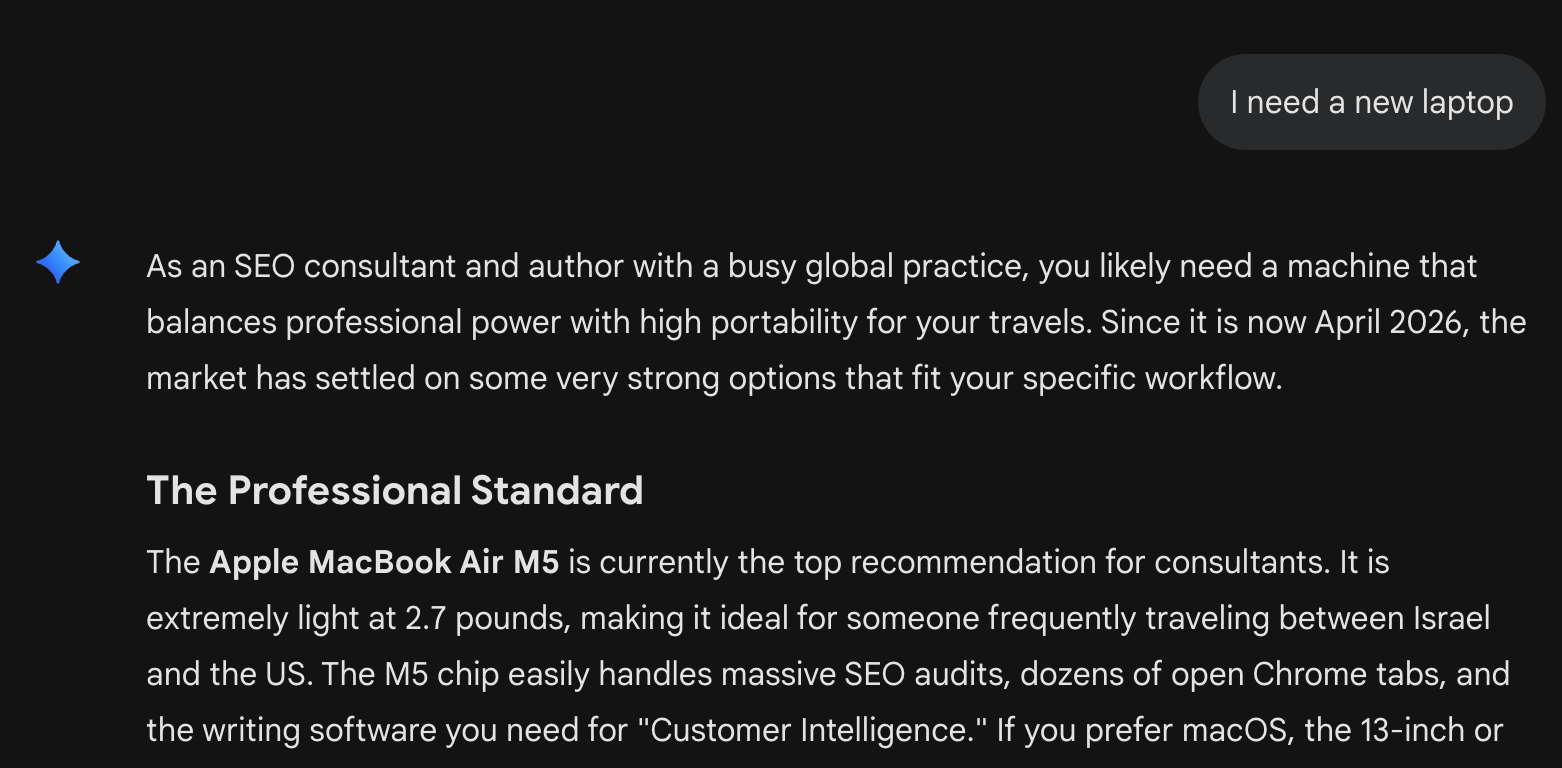
LLMs are different because the response a user gets is based on personal context, using the exact phrasing of their prompt, what they asked earlier in the same conversation, which platform they are using, and a set of internal weighting decisions that no external tool has visibility into. Ask the same question twice in the same session, and you may get a meaningfully different answer. Ask it on ChatGPT versus Claude versus Gemini versus Meta, and you are in entirely different territory. Selling prompt tracking as the AEO equivalent of rank tracking is selling a weather forecast on the basis of just looking out a window.
So what?
The practical implication of AEO not being an upgraded version of SEO is uncomfortable for anyone running an SEO program in 2026 pretending it’s still 2022, because the metrics you have been using to justify budget and prove performance do not map onto this new reality. If AEO is not a new version of SEO, you need different metrics.
Winning in an LLM means you are fighting to be part of the machine’s model of the world, and not just to "show up” in a report that you were visible. This requires the same inputs that have always built brand authority: third-party mentions, customer loyalty, and brand recognition metrics. These are the tactics SEO was always supposed to implement or partner with other teams, but rarely did, because traffic was easier to measure than the revenue impact.
You need to measure your success against this benchmark using real marketing, not SEO or AEO checklists. Ask your customers how they found you, and ask them about their journey to finding you, not just the last stop. These data points, tracked consistently over time, will tell you more about your LLM visibility than any prompt-tracking effort. LLMs learn about your brand from the world. If the world doesn't know you, neither will an LLM.
[Sponsored by North Star Inbound ]
What happens when you combine best-in-class SEO with conversion optimization?
BigRentz’s traffic increased by 186% (85k), added 1950 conversions in 12 months.
Self Financial’s traffic increased by 50k/month, and added 685 new customers.
Lastly, Secure Data added 1968 phone calls.
North Star Inbound’s SEO strategies earn leads, conversions, and revenue..
Book a call for a free content audit and 10% off any engagement.
Intrigued? [Learn more here]
Simple question: can you give me an example of one thing that you do, to be cited more in GEO/AEO/WHATEVERYOUWANNACALLIT that is not an SEO task?
this is why i dont think aeo is just "better seo". the user journey is different now. seeing more teams, including InBound Blogging, talk about this shift instead of treating it like another ranking game.