

Paid users can download this playbook to ensure they are ready for Meta’s LLM experience linked at the end
For the last three years, common wisdom was that ChatGPT was a serious threat to Google, and now, based on Google’s stock price, the assumption is that Google will be just fine. OpenAI and Anthropic will continue to nip at their heels, but in my opinion, will never seriously take over Google’s consumer search market share. However, there is one dark horse LLM that no one seems to be paying attention to: Meta.
In the early days of search, Google beat out its competitors (and there were many beyond just Microsoft and Yahoo) with three particular angles of attack.
Product - The search engine was superior to all of its competitors at the time
Simplicity - Most people learned how to search on a search engine that just did a search.
Distribution - Rather than spend money on user acquisition like AOL, Yahoo, MSN (Bing), Google made itself indispensable.
Google’s dominance was never just about a superior algorithm; it became a default. Among billions of Android devices, the Chrome browser, and massive payments to Apple to remain the iOS default, Google has embedded itself everywhere.
This distribution powerhouse even beat Microsoft’s inherent advantages, given its ownership of the desktop device market. The majority of those desktop users use the Microsoft Edge browser just once to download Chrome and become Google users. Windows has a ~70% market share, while its Edge browser has only 5%, compared to Chrome's 65%. (stats from Statcounter)
Only one company in the world can rival Google’s distribution: Meta
Meta has not become a contender in the LLM wars to date, despite spending enormous sums on the category; it does have an LLM, but it has not yet found success. Yet, there is no guarantee that they won’t make a serious play against Google.
Meta has distribution through its WhatsApp, Instagram, and Facebook platforms. According to Meta, it has 3.58 billion daily active people (the metric others call DAU). That is global dominance comparable only to Google.
While Meta hasn’t yet delved deep into information discovery (meaning not just LLM prompts but actual search), its surface-level attempts show the power it can wield. Today, when you go to WhatsApp to search for a contact or conversation, Meta suggests a discovery search. The same happens on the Facebook and Instagram mobile apps.
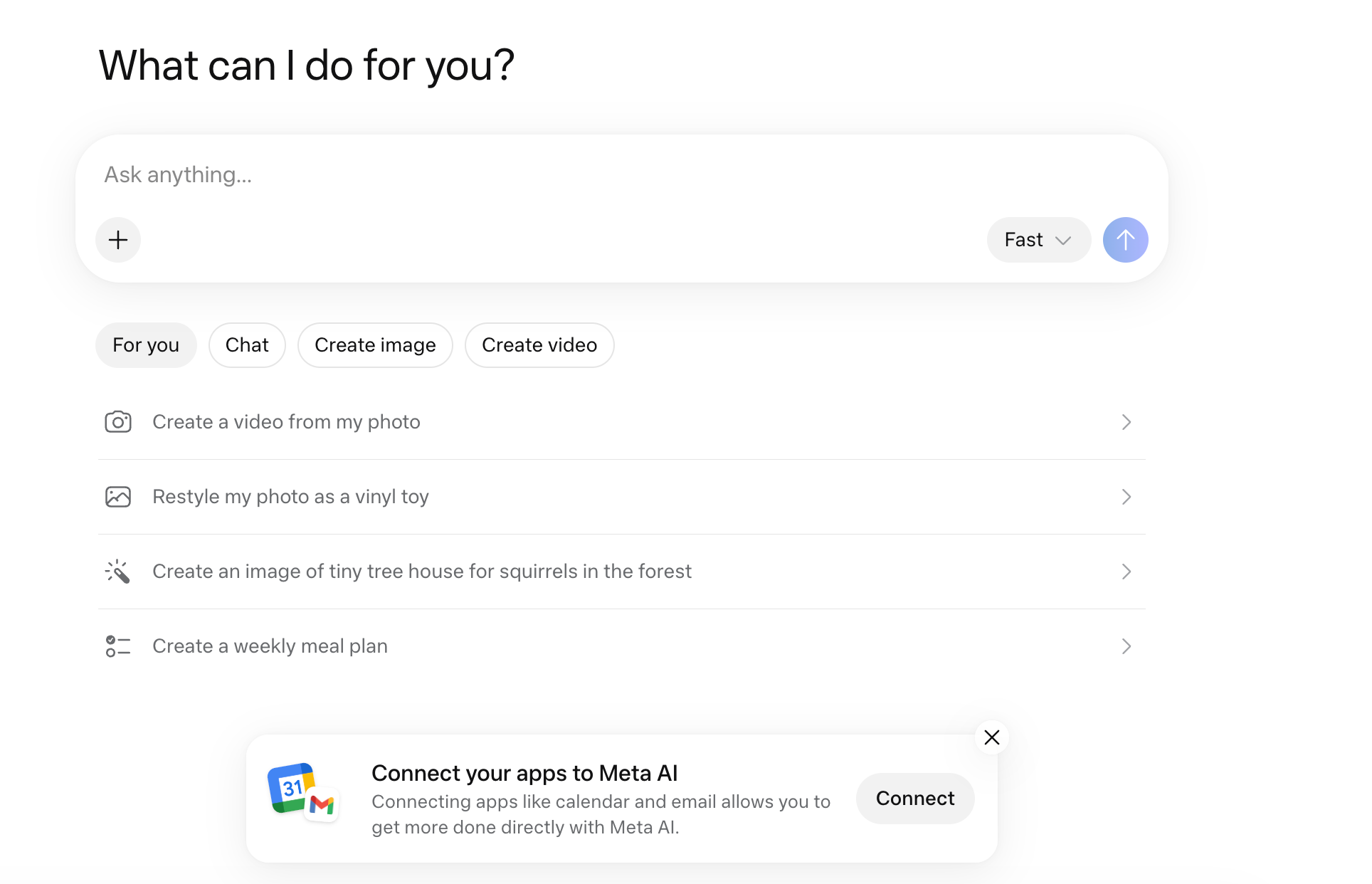
Meta even has an LLM landing page, which functions like any LLM, with image generation, chat responses, and the ability to connect to Google data.
Meta has monetization ready to go on Day One
One of Google’s biggest concerns in launching LLMs was the fear of cannibalizing its ad business. Google reportedly invented the concept of an LLM, but didnt’t explore the consumer side of it until they were forced to. This is likely holding back the continued AI-ification of search today, too, though I still think we will see AI mode become the default experience very soon.
Meta will have a far easier time of this because they are an engagement business; whether users engage with real friends on Facebook/Instagram/WhatsApp or synthetic ones in AI, it still meets their business metrics. Additionally, Meta’s ad model doesn’t require maintaining a counterproduct to AI like search. They can embed the exact same types of ads they have today into an LLM response without creating a trust deficit like Google will have to contend with.
Meta’s advertising infrastructure is already built for this
They already know how to make money from search-like behavior and have the advertisers already ready to spend with them. When you scroll through Instagram and Facebook, Meta is constantly serving you content based on your interests, and they’re monetizing that attention with sophisticated ad targeting. The infrastructure to show you relevant ads based on your queries already exists. They don’t need to build it from scratch like OpenAI is doing.
Meta’s ad platform is arguably more advanced than Google’s in some ways. They have detailed behavioral data on billions of people. They know what posts you pause on, what videos you watch until the end, what products you’ve browsed but never bought. That kind of behavioral insight is exactly what makes search advertising valuable. When someone searches for “best sports car” the advertiser wants to know if that person is likely to actually buy a car or if they’re just looking for pictures. Meta already has that data.
The shift in user behavior favors Meta
The traditional SEO world is built on Intent (what you type into a box). Meta’s advantage is Identity (who you are and who you trust). Younger users are already changing how they search for information; instead of typing queries into Google, they’re going straight to TikTok or Instagram.
Before all the handwringing over the death of Google from ChatGPT, everyone thought that Google was finished because of TikTok. This threat is back. Users will trust recommendations from people they follow more than they trust search engine results that might be gamed by SEO.
Meta has been waiting in the wings for this shift for years and is primed to maximize it. When someone asks their Instagram followers for restaurant recommendations instead of searching Google Maps, that’s a signal about where discovery is heading. Meta can integrate AI-powered search directly into these social discovery flows in a way that feels natural, not forced.
Even more powerful, Meta already has a mass-market wearable in its Ray-Ban Meta Glasses, which means it has its own platform to connect with its users that doesn’t require a Google browser, an Apple phone, or a Microsoft operating system as a bridge. As AI technology finally enables voice and visual search to be a better option than fat-fingering text, Meta Glasses levels some of Google’s advantage from Chrome’s browser domination.
Other challengers lack distribution
While Claude, OpenAI, Deepseek, Grok, and others make serious efforts to build market share, they still need conscious behavioral changes to attract users. Each of them requires a user to visit a new website, download a new app, and/or use a new browser to access their solutions.
Meta doesn’t need to convince anyone to change their behavior. 3.58 billion people use Meta A DAY. Meta just needs to make search a natural part of the experience that’s already happening. That’s a much easier sell.
Stealing Google’s crown doesn’t have to mean taking 51% of the search market; shaving a few percentage points off of their share could be catastrophic. Additionally, as Meta made users more accustomed to using its platform for information discovery, it could grow its reach across all the places where Google had built dominance.
Local as an opportunity
Facebook pages have lost popularity as the Facebook ecosystem declined. Still, a reinvigorated Meta injected with search would make these pages relevant again in a way that would threaten Google’s local pages. Right now, if you want to find a restaurant near you, you Google it.
But what if Instagram and Facebook already knew which restaurants your friends loved, which ones you saved posts about, which ones you engaged with? Meta could serve up personalized local recommendations of these Meta pages. (Instagram/Facebook and even WhatsApp business profiles) that are informed by your actual social graph, not just anonymous reviews from strangers.
This presents the first competitor to Google on the local side since Google obliterated Yelp. For local businesses, this could mean that maintaining an active Facebook or Instagram presence within Meta's walled-garden LLM is more valuable than ranking well in Google search results.
It’s not just Instagram and Facebook that slots neatly into how we think of search today, where social profiles = websites, but this is an even bigger paradigm shift. Meta is moving toward search to transaction. Already, on WhatsApp, you can find a business, chat with their AI (or human), and purchase, without leaving the app.
Google sends you to a third-party website, where it no longer has any control over the experience. Meta’s ability to own the full funnel is the super-app Google has always wanted to be. (Note, Google’s failures in social media, mortgages, car-buying, and more. One of the only verticals where Google has managed to stick the super-app experience is travel, where you can find, book, and pay for a hotel all on Google. ) Meta can even enable agent capabilities on WhatsApp, allowing their business customers to use agents without building new integrations or other agent product offerings.
If you are sleeping on WhatsApp for Business, wake up.
What this means for marketers
Meta can experiment with giving users direct answers instead of showing them ads, because they’re not dependent on search ads for revenue. The white space for experimentation allows for a more comfortable user experience, which could eventually lead Meta to capture search market share almost by accident.
I don’t see any tools discussing LLM visibility on Meta, but maybe it’s time to do so. More importantly, for businesses of all types, now is the time to reinvest in a Meta strategy because that presence is about to be more important than just social.
Paid users can download this playbook to ensure they are ready for Meta’s LLM experience.
The future of search isn’t going to be stolen by a better version of Google, as the Perplexity’s of the world are trying to do. AI discovery is here to stay, so the future will be owned by the platform that makes search feel like a natural extension of the apps we never close. Meta’s LLM isn’t going to be about backlinks, citations, markdown, LLM.txt, and all the other snake oil sold by the “SEO is dead” crowd; it’s about UGC at scale, and that is a lot harder to fake.
Regardless of whether Meta becomes the new Google, Meta’s LLM is one that you will not want to ignore.
You've made a great point. Meta played two awesome moves by acquiring WhatsApp and Instagram.
Most people spend more time on social media than on Google search. And the major social media sites are owned by Meta.
1. Facebook - 1.9 billion monthly active users
2. Instagram - 1.21 billion
3. WhatsApp - 3 billion
4. Threads - 400 million
These platforms have the attention. And now attention is the new oil. Brands are spending billions to get attention.