

This week’s newsletter is sponsored by Stacker and Ahrefs.
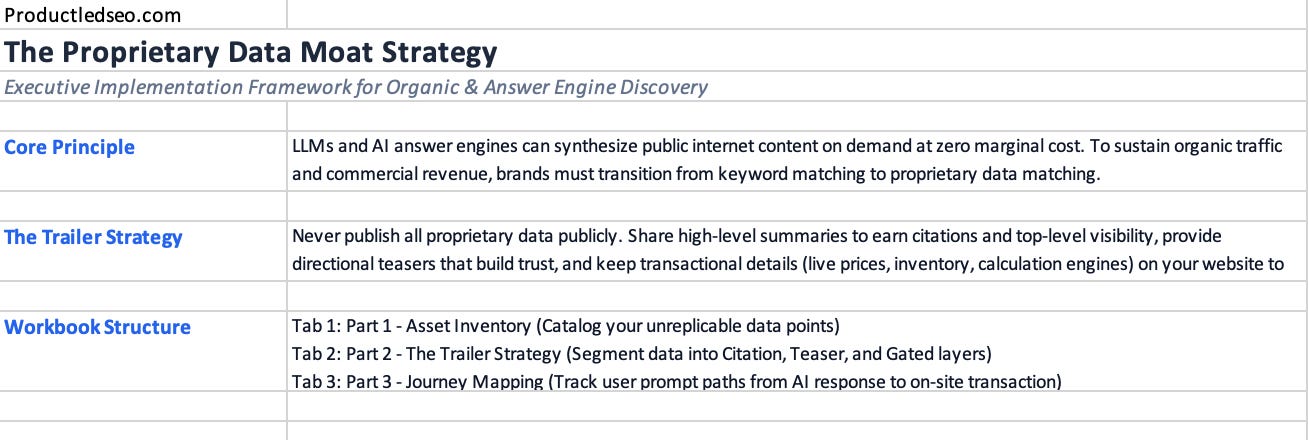
Paid subscribers can download this dashboard to analyze their proprietary data strategy
[Sponsored by Dofollow] Your buyers are asking AI what to consider. Visibility+ from dofollow.com helps B2B SaaS brands build the authority necessary to improve visibility across AI answers and traditional search. See where you’re missing.
Most SEO teams still compete for the same keywords with content any AI model can now produce on demand, and they are confused about why rankings that held for years have suddenly evaporated.
[Sponsored by Ahrefs]
Ahrefs SEO MCP plugs live Ahrefs data straight into ChatGPT, Claude, and other AI tools – no code, no API scripts, no tab-hopping. Ask in plain English and get back real keyword, backlink, traffic, and competitor data, already analysed.
"Show the top 20 trending terms in my industry with strong growth potential through 2026." "Which of these 10 competitors grew organic traffic in the last 6 months?"
The research that used to eat your morning now takes one prompt.
Check it out here.
The confusion comes from not understanding why users search; they have a job to do, not just to read content. The labor required to produce content, even well-researched content, stopped being scarce the moment an LLM could generate the same on demand. Capital and human resources were always the real currency of SEO, not the content itself, and once that scarcity disappears for anyone with a browser and an LLM, traffic goes away, no matter how much internal link equity or backlink history a page has accumulated.
Match the need, not the search
The only sites that will truly earn traffic aren't those with content that precisely matches a query or prompt, but those with data that matches the need. That is the internet's true product: data that exists only inside your product, your users, or your operations, because a model trained on the public internet can't generate something it has never seen, and no competitor can replicate that data by hiring a bigger content team.
I saw this directly at many companies where I worked or consulted. At Cars.com, it wasn’t the car research, which was somewhat commoditized, but it was the car listings. At Tinder, it wasn’t the content that matched dating keywords, but it was the “inventory” of people that matched desires. In both of those cases, a competitor with a better writer could never replicate that strength because the value was never the writing.
The disappearance of writing as a moat is a clear instance of Blue Oceans and Red Oceans. Red Ocean SEO means opening a keyword tool, seeing what everyone else already produced, and writing something marginally better optimized than the incumbent. Blue Ocean SEO means building content around what your product and your users actually know that nobody else has access to. The first strategy scales with effort, and AI has made that worthless. The second strategy scales with access, and a competitor can't automate it, no matter how much budget they throw at content production.
Most current AEO advice tells brands to optimize for citations or structure their content better for LLMs, but it ignores that the content may be the issue, not the structure. If your content synthesizes information that already exists publicly elsewhere, an LLM has likely already replicated it, and anyone can produce it on demand. In either case, there is no compelling reason to visit your website, even if you are cited. This is a challenge that many affiliate websites face right now.
Proprietary data’s impact
Proprietary data changes this paradigm, because a model cannot replicate the color that comes out of data. A model can give a basic ballpark figure, but only Zillow can estimate a house’s value, Similarweb the traffic makeup of an LLM, and Expedia the history of a flight’s price.
None of this is a ranking position that an algorithm update can strip away overnight. Every additional day your product runs, the dataset grows, and the gap between you and a competitor starting from zero widens.
To be transparent, data advantages don't last forever. Competitors can build the same dataset over time, so this moat will decay. To counter this, you still need to iterate and improve, not just rest on your laurels.
This also explains why AEO functions more like brand building than traditional SEO, a point I have made in many posts this year. You cannot manipulate your way into being the canonical source the way traditional SEO used to manipulate backlinks and keyword stuffing. Authority in this environment is earned by having the data and answers searchers want. Data isn’t the only key because someone with incredible data but zero reputation will still lose to someone with weaker data and stronger trust in their space.
When SEO teams prioritize traffic or visibility, their first instinct is to publish as much content as possible, but that is a mistake. The data is the currency that will keep people coming to a website in an environment where search clicks keep declining. The SEO team should develop a strategy that teases enough proprietary data so that when a company is cited in a response, the next step is for a user to either click a citation or do a follow-on search that brings them to a website for more. Only in this scenario does LLM visibility drive revenue. Without a reason to click, the visibility is just vanity.
Treat data like money
The AEO transition most companies still need to make is treating internal data as a published asset, not an operational byproduct that sits in a product. You have this data in your company; now you need to figure out how to use it. Come up with that teaser strategy. If you are a website selling live event tickets, the LLM will never sell that ticket, so you want to be cited for the ability to sell it. Give away enough information about the event, but never reveal proprietary details like the price. The follow-up search for information about the event might be how much it costs, and that's when you get cited and clicked.
In the same vein, this is why anytime I've worked with an entertainment company that wanted to share their assets on YouTube, I always counseled against it. If all their information is free on YouTube, there is no reason anyone would click through to come to their site. They should always use the time-tested strategy of sharing trailers, not full videos.
An e-commerce company’s purchase and return behavior across categories tells a story no third-party research firm can tell without access to the actual transactions. A marketplace’s supply and demand signals across geographies are more valuable than any keyword research tool on the market, because a keyword tool estimates intent while the marketplace records actual behavior.
Anyone can hire a better writer, but they can’t recreate your data. Proprietary information is your offense and your defense. Use it; don’t share.
[Sponsored by Stacker]
Every SEO lead I talk to now agrees that earned media drives AI visibility. Very few of them have it in their budget.
When I ask why, the answer is almost always the same: “How would I report on it?”
That’s a fair concern. Budgets follow measurement. A channel you can’t report on gets cut in the next planning cycle, however strong the logic behind it.
The traditional PR scorecard (impressions, share of voice, a clipping book) stops short of the question leadership cares about now: did ChatGPT, Perplexity, or Google’s AI Overviews actually use that coverage in an answer?
To answer that, measurement has to happen at the story level. Which specific story ran, where it ran, and which AI platforms cited it afterward. Once you can see that, you can do what SEO teams have always done well: find what works and do more of it.
This is the part of Stacker that caught my attention. They distribute brand stories across 3,000+ vetted news publishers as native editorial placements, and their GEO Reporting tracks how each distributed story performs across AI search platforms, directly in their portal.
That gives you something concrete to bring into a budget conversation: here’s the story, here’s where it ran, here’s where AI engines cited it.
Pick one story you'd want AI engines citing next quarter. Then book a demo and see what Stacker's reporting would show you after it runs. Your first story is included free through my link