

This week’s newsletter is sponsored by Ahrefs
Paid subscribers can access my TAM template, which could help with your planning.
I have $200 Intro coupons available for the first 5 people who respond asking for one. Just reply to this email.
I recently sat down with a group of digital marketers to discuss 2027 SEO/AEO efforts, and I asked how many of them had a formal plan for their SEO efforts over the past year. Not a single hand went up. I was completely surprised by that response, as the opposite of a plan is either winging it by just coming up with things to do or taking direction from someone else in the org who actually has a plan.
Planning is one of the most essential functions in any business because a plan drives hiring, budgeting, messaging, and every other aspect that makes a business successful, or not. Teams, employees, and even agencies that don’t build their own plans end up following someone else’s. The best way to ensure your priorities are considered- because your priorities and passions drive your happiness and success in a role- is to build a plan.
[Sponsored by Ahrefs]
Most “free” SEO tools are just a seven-day countdown in disguise, requiring a credit card before locking you out of your own data.
Ahrefs Free gives you permanent access to six essential marketing tools so your brand can get discovered across traditional search, AI, and social platforms without a ticking clock.
Sign up for your free-forever account today with no credit card required, and start building sustainable visibility on your own terms.
Check it out here.

Planning is essential
While some organizations' structures might not let you drive the plan, not having one guarantees you won't own it. I've seen many companies budget for and develop SEO plans (and now AEO) for a team that isn't in the room, but it's impossible to make the case to join that room without something new to add to the conversation. That is a plan.
In the closing quarter of the year, when many businesses plan the next year, now is the best time to develop and present your SEO plans for 2027.
Want more headcount on your team in 2027? Now is when you ask.
Want to buy a new enterprise tool? Q4 is when it gets allocated.
Want to increase your learning and development budget so you can register as an early bird for conferences? Ask for it before the books close.
Budgets close before the year does
In my experience, most SEO budget requests get denied because they aren't made during the formal planning cycle. If you show up in February of next year and ask for a new employee just to manage AI visibility (spoiler alert: you probably don’t need one), they'll almost certainly reject it because there isn’t a spare $150K sitting around waiting to be spent. If the business decides it’s a priority, then they would have to pull it from something else, which most likely has a team that doesn’t want to give it up. They will fight to keep it.
If that same request were made right now, it would have a much higher chance of success because the CFO and budget committees are dividing up the spend pool, and those funds don’t need to be pulled from anywhere. These requests get easier later in the year once, hopefully, a company beats its annual projections and has more unallocated budget, or other teams haven’t used all their funds as planned to date. But why wait? Use this time now to think through next year and get your wishes granted.
ROI forecasts are required
While many teams I have met have very thin budget requests, if they have any at all, most are missing the critical component of a good budget request: the outcome. Many teams, not just SEO teams, march into a budget planning session with a wish list without saying what they will return to the company. The objective of a plan is to get the holders of a budget to make investments, not to give grants. For that to happen, the request has to include an ROI.
ROI is one of those things that SEO teams have had the hardest time ever getting right, and for most of the past two decades it didn’t matter because even without a clear line of sight from search to conversion, it was plainly obvious that the revenue earned in aggregate by channels that were considered to be search was orders of magnitude larger than the spend on the channel.
That changed over the last three years, when traffic suddenly started shifting away from organic channels because of the triple whammy of Google algorithm updates, AI Overviews, and AI chatbots. I still believe organic channels are as profitable as ever if you use more proxies (see this post), but for a leadership team that has not been sold, it definitely looks dire.
The answer to this is to build a logical ROI plan. I am a big fan of using TAM as a forecasting method because it doesn’t require a perfect line of sight to conversion; it maps the journey and forecasts success without needing attribution. This lets you fund other marketing channels without a perfect last-click model.
Also, now is the time to adjust your reporting to show the impact of AI traffic using proxies, so you can more easily defend your efforts next year. You will be in quite the bind if you budget and plan based on TAM but then still get measured on last click.
What the plan needs to say
A plan is not a forty-slide deck full of keyword volumes and competitor screenshots; that’s how you lose your audience. What works is a short, three- to five-page document that says what you will build, what it will cost, when you will do the work (broken down by quarter), and what the business should expect to see at the end of each quarter.
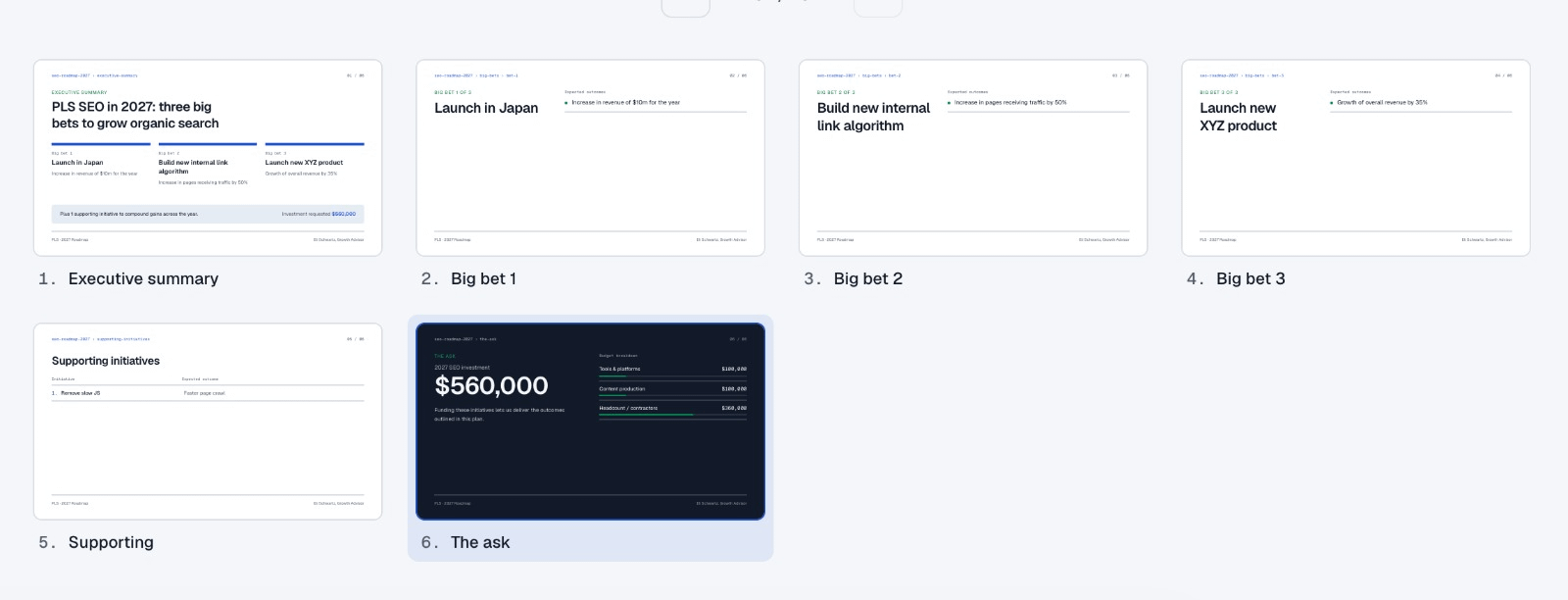
(I am building a tool that generates presentations for roadmap planning; see more information at the bottom of this email.)
Planning for the whole year, not just quarters, matters because you might put in the effort in Q1, but the results don’t show up until Q4. SEO/AEO are not instant successes. You need to make clear that these aren’t open-ended investments, but they are also not performance marketing type of efforts where the results happen in the same quarter. Being held to a schedule feels risky, but it is what makes this an investment, not a gift. If you are the CMO on the receiving end of one of these plans, use this checklist for an SEO plan: a cost, a date, and an outcome for every bet, or send it back.
Don’t overshoot
Pick three or four bets and stop there. Every extra initiative does the opposite of what you intend. It dilutes your focus and makes the plan harder to sell. Say you propose rebuilding a product category and expect it to drive a specific number of qualified leads by the end of the year; that plan can be clearly judged on its merits, while a list of ideas can’t.
Your goal isn’t to solve everything; you want to complete these initiatives, and you need more than budget to get others to support you. This plan forces a conversation with the teams you depend on. SEO plans fail more often from missing engineering time than from bad strategy, because the in-house SEO owns the outcome but has no authority over the engineers and product managers who control the inputs.
The plan is your promotion case
A plan is your promotion case for this coming promotion cycle, but even if you aren’t so fortunate, it becomes your record for the next one. You get a chance to show leadership by developing a plan, managing toward it, and then meeting it. The person who walks into planning season with an outline of what will happen is the person who gets asked what they would do with more people, a larger scope, or a seat at the leadership table.
You may not need a plan for your boss; I hope you do, but if you don’t, you should still have an outline of what you hope to get done in 2027 and work towards that goal. SEO and its AI byproducts are important enough that you shouldn’t just be winging it.
I am building a suite of tools to help SEO teams and need beta testers. The first tool will build a roadmap pitch for budget, and I'm looking for beta testers. Reply to this email if you'd like to try it.
[Sponsored by LLMNTS.ai]
*Citations are the new links. Let’s not repeat the mistakes.*
We’ve spent 20 years learning what happens when link building becomes a race to the bottom. Yet somehow, we’re watching the same thing happen with AI citations. Automated Reddit posts, low-quality listicles, and placements on websites nobody actually reads.
The funny thing is, we have no shortage of tools telling us where brands are missing citations. But who’s actually getting them? SEO points to PR, PR points to the agency, and the agency points back to the client. Everyone agrees it’s important. Nobody owns it.
That’s why the team behind LLMNTS built the service in the first place. They couldn’t find anyone doing it the way they thought it should be done.
LLMNTS.ai works with some of the world’s leading publishers to get brands into the articles and conversations that shape AI answers. It’s the part of AEO everyone talks about, but few actually execute.
*Worth a look if you’re serious about AI visibility beyond the dashboards.*
Check out LLMNTS →